As part of Anglistikos akademija, students from Vincas Kudirka Gymnasium in Kudirkos Naumiestis visited the Faculty of Philology at Vilnius University to attend a series of interactive sessions on academic writing, spoken communication, foreign-language pronunciation, and the relationship between human language and technology.
🌹🌿Building a Strong Academic Essay
Led by Lecturer Jurga Kasteckienė, this practical session introduced students to the essential elements of academic writing, from constructing effective topic sentences to organising arguments and developing meaningful conclusions. Through practical exercises, students evaluated sample sentences and explored how introductions, body paragraphs, and conclusions work together to create clear, coherent texts.
A key focus was cohesion and coherence—how writers connect ideas and guide readers through an argument. Students discussed transition signals, pronouns, synonyms, and information structure, as well as the importance of adapting language and tone to the intended audience. They also discussed how a strong conclusion can bring an argument together and leave readers with a meaningful final thought.
🌹🌿The Voice of Language: Exploring Phonetics, Music, and Communication
In an interactive session led by Assoc. Prof. Dr Giedrė Balčytytė, students explored how meaning is conveyed not only through words but also through vocal expression, facial expressions, and body language.
Experimenting with the phrase “I’m fine”, they discovered how the same words can communicate happiness, uncertainty, irritation, or sadness depending on how they are spoken. They also discussed key features of spoken language, including pitch, intonation, prominence, rhythm, speech rate, and pauses. By changing the emphasis in “I thought you knew” and experimenting with silence, students observed how vocal choices can alter a message’s implied meaning and influence its interpretation.
The session showed that it is not only what we say, but how we say it, that makes all the difference!
🌹🌿🇩🇪 Tongue Twisters and German Pronunciation: Learning Through Wordplay
Led by Assoc. Prof. Dr Diana Šileikaitė-Kaishauri, this lively session introduced students to the playful side of German pronunciation.
The German word Zungenbrecher literally means “tongue-breaker” and refers to expressions that challenge speakers with sequences of similar sounds. Students and their teachers put their pronunciation skills to the test with ten tongue twisters, including:
🇩🇪 Fischers Fritz isst frische Fische, frische Fische isst Fischers Fritz.
🇩🇪 Bäcker Braun bäckt braune Brezeln.
🇩🇪 Es grünt so grün, wenn Spaniens Blüten blühen.
The activities encouraged participants to pay attention to challenging consonant combinations, vowel distinctions such as ä and ü, and the precise articulation of German sounds. All ten tongue twisters were practised collectively, turning pronunciation exercises into a shared experience. Students also introduced tongue twisters from their own languages, comparing the distinctive sounds and patterns of different linguistic systems.
🌹🌿Transformations in Communication: From Natural Language to Machines
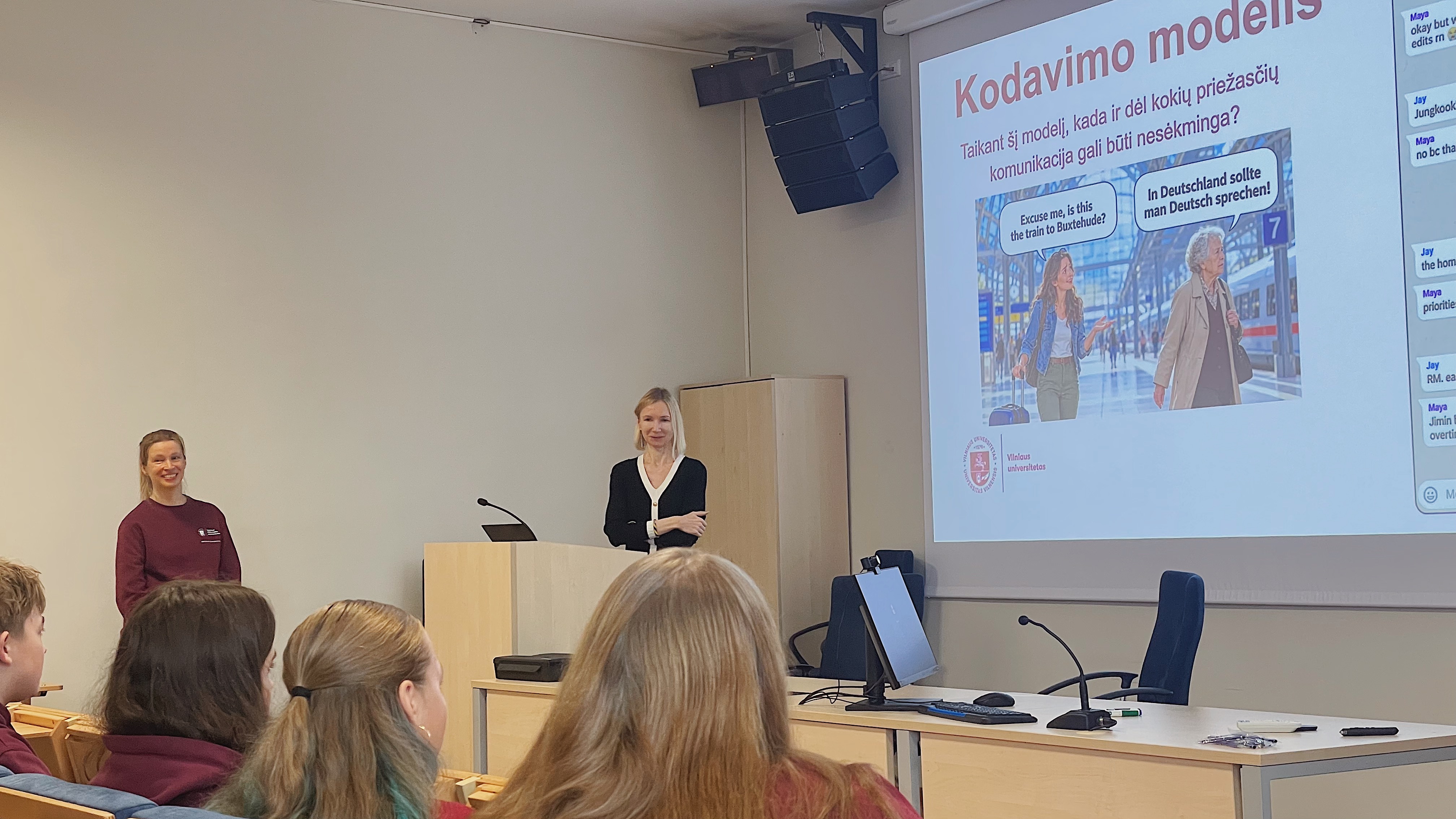
In an interdisciplinary lesson, Assoc. Prof. Dr Agnė Brilingaitė and Assoc. Prof. Dr Virginija Masiulionytė reflected on the changing nature of communication in a world increasingly shaped by technology and artificial intelligence.
Language enables us to share information and knowledge, express and understand human identity, and maintain interpersonal relationships. Computers, meanwhile, allow us to store and process information and facilitate rapid communication. Bringing these perspectives together, the session focused on the concept of human–machine communication and compared communication between people with communication involving machines.
Students were encouraged to consider how artificial intelligence is transforming the ways we learn, work, and communicate, and to reflect on the evolving relationship between human language and technology.
Prepared by Maria Dreer, a fourth-year English Philology student, as part of her Intercultural Communication Internship.