🎨 BA Mentorship Night at MO Museum: Is This Real? Art, Technology and Us
What happens when art meets artificial intelligence? Can technology connect us, shape our identities, or change how we understand reality? And how much of our digital world is truly separate from the physical one?
During our BA mentorship group’s visit to MO Museum’s exhibition Is This Real? Art, Technology and Us, these questions became a starting point for exploring the complex relationship between technology and everyday life.
Rather than providing straightforward answers, the exhibition encourages visitors to look closer, question familiar assumptions, and interpret the artworks from different perspectives. Across six sections, it explores the intersections of technology, nature, communication, power, identity, and intelligence.
Even the exhibition space reflects these themes, with an architectural design reminiscent of an electronic device or computer circuit board. The setting reinforces the idea that technology is not simply something we use, but an environment that increasingly shapes how we live, communicate, and understand the world.
Here are some of the artworks and ideas that stood out during the visit!
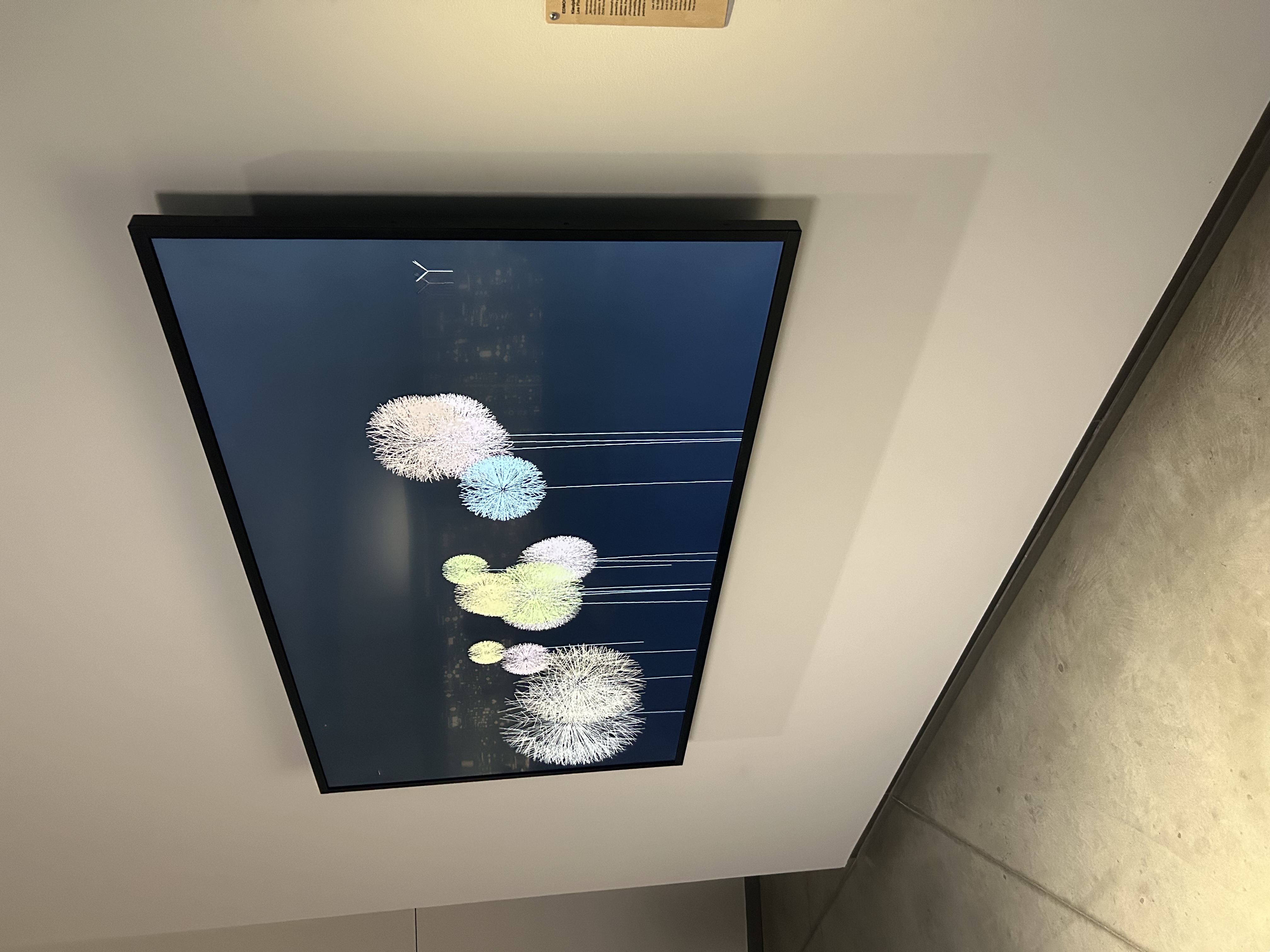
Art that responds to us: Dandelions (1990)
What happens when a simple breath becomes part of a digital artwork?
In Dandelions, visitors blow into a microphone, and the image on the screen changes according to the strength of their breath. Created in 1990, the interactive work offers an early example of digital art responding to actions in the physical world.
Although its technology may seem simple today, the artwork explores an idea that remains relevant: the boundaries between the digital and physical worlds are not always as clear as they appear. It also shows how technology can make artistic experiences playful, interactive, and closely connected to nature.
Looping Networks: Connection, control, and power
Networks are much more than the internet. They can connect people, ideas, and environments — but they can also create dependencies and enable surveillance, control, and exploitation.
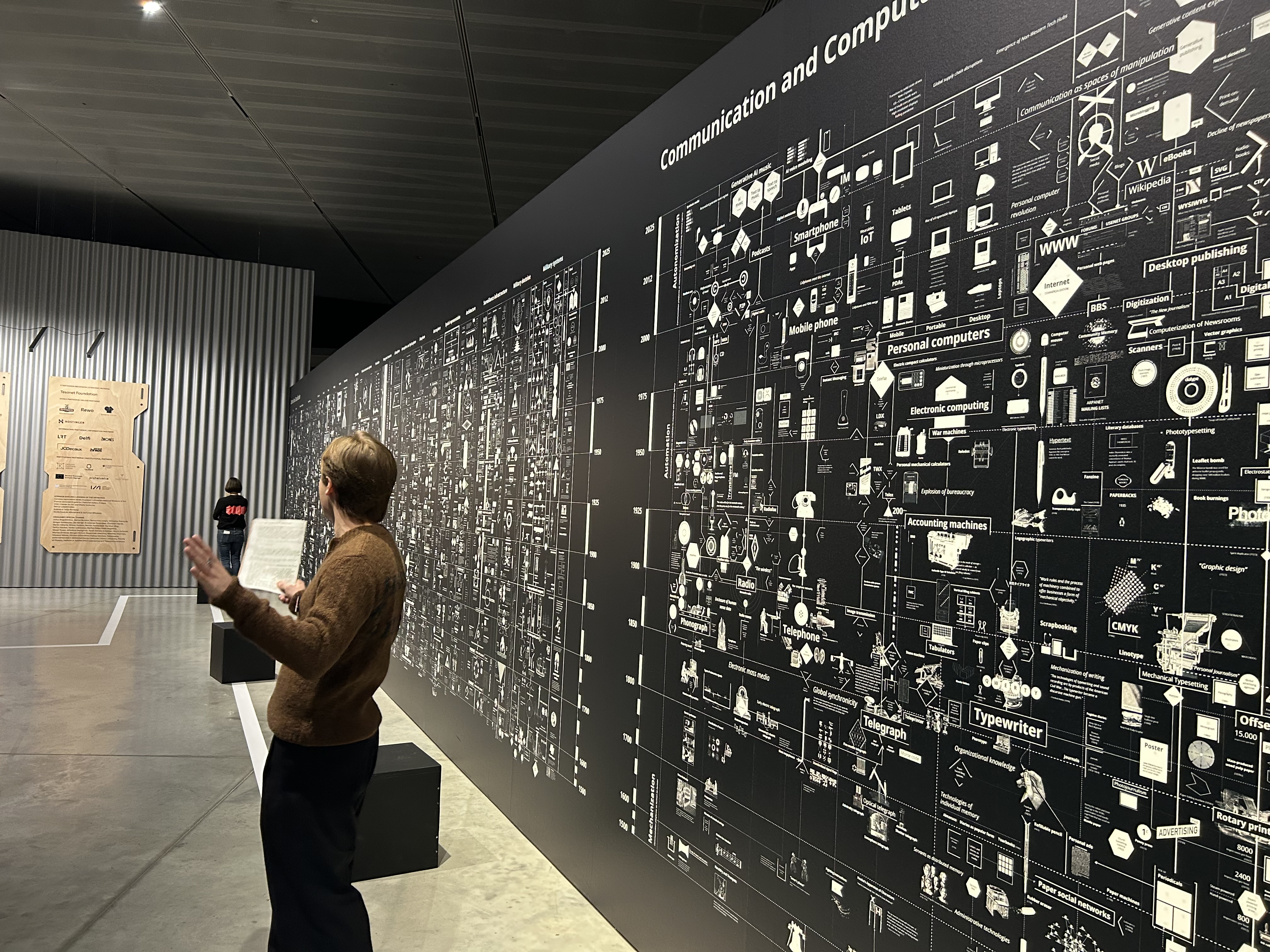
One striking work in the Looping Networks section is an extensive diagram mapping the relationship between technology and power since 1500. Compiled over almost four years, the archive traces five centuries of technological development, communication, and data collection, connecting these histories with the human body, colonialism, psychology, and politics.
The project challenges the idea that artificial intelligence emerged suddenly in recent years. Instead, it places contemporary technologies within a much longer history of interconnected developments, while raising questions about how knowledge is collected, organised, and presented.
Nam June Paik: Imagining a connected world
Long before digital communication became part of everyday life, Korean American artist Nam June Paik explored how electronic media could connect people across geographical and political borders.
His work Wrap Around the World was broadcast via satellite during the 1988 Summer Olympic Games, reaching an audience of nearly 50 million people. Featuring artists and musicians, including David Bowie and Ryuichi Sakamoto, the broadcast offered a vision of global connection at a time when the Cold War continued to shape international relations.
The work highlights the potential of technology to bring different cultures into contact, while also suggesting that communication alone does not guarantee mutual understanding.
A vision of the internet before the internet: Internet Dream (1994)
Paik’s Internet Dream continues this exploration of global communication. Having imagined worldwide electronic networks as early as the 1970s, he anticipated many ideas that would later become central to the internet.
Created in 1994, the installation consists of 52 television monitors displaying rapidly changing images from different sources. Together, they create a dynamic collage that feels surprisingly familiar in an age of social media and endless scrolling.
The work also draws attention to the physical infrastructure behind digital experiences. Screens and devices may deliver seemingly immaterial content, but they depend on tangible equipment, energy, and maintenance. Because the installation uses ageing technology that is difficult to repair or replace, it must be switched on at 11 a.m. and off at 7 p.m. each day to prevent overheating.
Internet Dream makes visible a side of digital culture that is easy to overlook: even our most virtual experiences depend on the material world.
Automation and Intelligence: Is AI really neutral?
The Automation and Intelligence section examines humanity’s long-standing ambition to automate decisions, predict outcomes, and make everyday life easier.
Artificial intelligence is often presented as a driver of progress, but AI systems are not inherently neutral. They can reproduce social biases and gender norms, rely on human labour, and depend on physical infrastructure such as data centres, which require energy, cooling systems, and water.
These processes often remain hidden from users. By bringing them into focus, the exhibition encourages a closer look at the systems behind the technologies we use every day — and the assumptions embedded within them.
The Infinity Engine: Engineering the future of life
How far should we go in redesigning life itself?
Created by American artist Lynn Hershman Leeson in collaboration with biologist Josiah Zayner, The Infinity Engine explores genetic engineering and its potential to transform living organisms. Drawing on the environment of contemporary bioengineering laboratories, the installation examines how scientific spaces can become sites not only for studying life, but also for intervening in its fundamental processes.
Developments that once seemed to belong to science fiction are increasingly part of real-world research, opening up new possibilities while raising complex ethical, social, and political questions.
Building on Hershman Leeson’s longstanding exploration of technology, identity, surveillance, and media, the work invites visitors to consider the boundaries of human intervention in DNA. Who should decide how far genetic engineering can go? What responsibilities come with the ability to alter life? And how might these decisions shape humanity’s future?
Can a computer understand warmth?
In an artwork by Julia Vollmer, a computer running a language model is positioned with a candle attached beneath it. Given a task related to keeping the candle warm, the system generates a stream-of-consciousness text about warmth and candles. Meanwhile, the heat produced by the computer gradually melts the candle, making the machine’s physical effects part of the artwork.
The installation creates a thought-provoking contrast between language and experience. A computer can generate descriptions of warmth, but does that mean it understands warmth as a human experience?
By connecting digital language with a physical process, the work explores both the limitations of artificial intelligence and the material consequences of technologies that can otherwise seem intangible.
When an image looks real: AI, representation, and truth
Artificial intelligence is also changing how images are created — and how we decide whether to trust them.
In one work, an artist takes inspiration from an AI-generated image of a coat and transforms it into a physical object. The process draws attention to the relationship between representation and reality.
Photographs have traditionally been treated as evidence of something that exists or has happened. AI-generated images complicate this assumption by making it possible to create convincing visuals without depicting anything real.
The artwork raises an increasingly relevant question: what makes an image believable? Its meaning depends not only on what we see, but also on the context in which it appears and what we know about how it was created.
In a world where images can be generated, manipulated, and presented as authentic, critical visual literacy has become more important than ever.
Connecting the dots: What does it mean to live with technology?
Although the exhibition is divided into six sections, its themes frequently overlap. Together, the artworks explore technology not as an isolated field of innovation, but as something deeply connected to human history, social structures, the natural world, and everyday experience.
From interactive digital landscapes and global communication networks to genetic engineering, AI-generated images, and machines that attempt to describe human sensations, the exhibition invites visitors to consider both the possibilities of technology and its limitations.
It also leaves us with some important questions to take beyond the museum:
Can technology truly bring people together, or does connection require something more?
Can artificial intelligence understand human experiences, or can it only reproduce descriptions of them?
When an image looks real, what makes us believe it?
How far should we go in changing the building blocks of life?
And as technology becomes increasingly embedded in everyday life, where do we draw the boundaries between the human and the artificial?
Our BA mentorship evening at MO Museum offered an opportunity to explore these questions through art, discussion, and shared curiosity. The exhibition demonstrated how art can make complex technological issues more tangible, encouraging reflection on the systems that shape our lives and the futures we are creating.
Perhaps the central question is not simply “Is this real?” but also “How do we decide what is real?”🎨
Prepared by Maria Dreer, a fourth-year English Philology student, as part of her Intercultural Communication Internship.