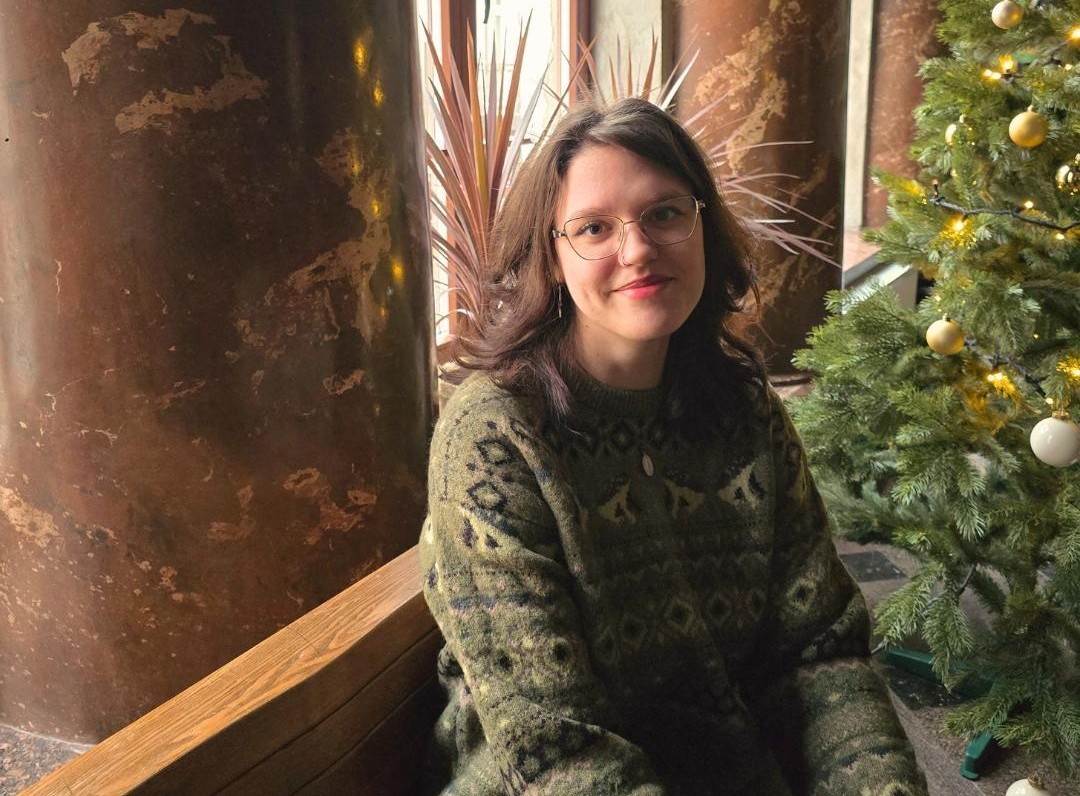
Awarded the Nordclinic Group one-time scholarship for academic excellence, fourth-year English Philology student Fausta Bauer stands out not only for her achievements but also for her curiosity and initiative. From research to volunteering, she approaches every step of her studies with enthusiasm. Here, Fausta shares the experiences that have shaped her academic path and the advice she offers to those following behind her.
What in English Philology has most inspired or challenged you so far?
It is quite difficult to pinpoint what exactly inspires me most in English Philology because I genuinely enjoy all aspects of it, from literature to linguistics. I have faced challenges in both areas, but I can confidently say that anything involving numbers is not my strong suit, such as the statistical side of linguistics. Unfortunately, my mind cannot quite wrap around mathematics.
Based on your successful summer research experience and the insights you gained through your LMT-funded project “Unreliable Narration in Irish Literature and Film: The Case of Colm Bairéad’s Adaptation of Claire Keegan’s Novella Foster” (supervised by Dr Deividas Zibalas)— from deepening your understanding of Irish literature and film adaptation to presenting your findings at a national conference — would you encourage other students to apply for Research Council of Lithuania (LMT) funding or similar opportunities? Why?
I would absolutely encourage it, and I’d even say that everyone should make a habit of applying for opportunities like that. It is really easy to get caught up in “what ifs” and worst-case scenarios about not being chosen or not succeeding. But in the end, whether you win or not, the most valuable thing you gain is the experience itself.
You’ve generously volunteered in many English Philology programme-related activities — what draws you to give your time and energy in this way?
I’ve always been naturally drawn to volunteering and programme-related activities. Even in secondary school, I split my time between schoolwork and a variety of extracurricular and volunteering commitments. I enjoy helping others and feeling like I’m contributing to something bigger than myself; it’s as simple as that.
What keeps you going during tough weeks when everything piles up — studies, volunteering, deadlines?
What helps me most is imagining a moment in a few days, a week, or even a month when those deadlines are gone and the workload is lighter. That vision motivates me. Surprisingly, it works like a charm every time. It shifts the mindset from frantically moving from one deadline to the next to steadily working towards a more relaxed future.
What advice would you give to a first-year student who hopes to follow a similarly active and successful path?
This will sound quite banal but just go for it. It is quite difficult starting something new when you’re in the first year because most first-year students need to figure out how to navigate a whole new mode of living. But whenever you feel ready, volunteer, apply for scholarships and special programs, take advantage of the opportunities available. In the worst-case scenario, you can always try again next year.