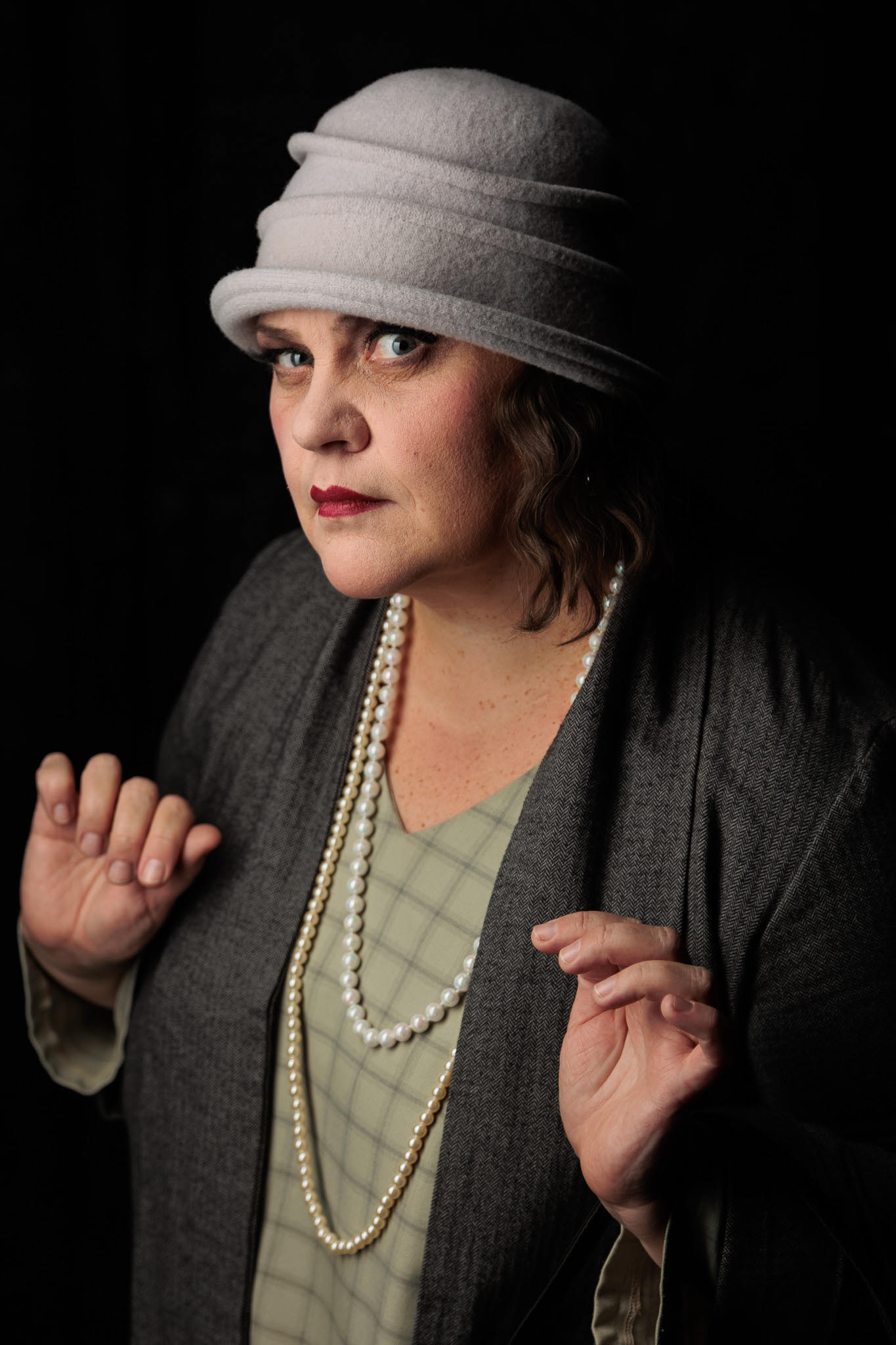
“Being the only literary genre which successfully creates the illusion of human interaction taking place impromptu, drama has always fascinated me.” explains Dr Jelena Kirejeva, an Assistant Professor at Vilnius University and an actress devoted to the arts. Kirejeva presents herself as a multifaceted personality, discussing her experience in theatre, film, and various linguistic fields such as conflictology, pragmatics, and discourse analysis, all of which ties in with her artistic work.
You have a course titled “20th-21st British Drama through the ‘Pragmatic‘ Looking - Glass”. What insights can the linguistic–pragmatic lens offer when studying modern British drama, and has this perspective influenced your own creative endeavours in theatre or film? If so, how?
The course I designed stemmed from my PhD dissertation. It was an attempt to merge drama and linguistics. The two spheres are contiguous, overlapping, and interpenetrating. However, the idea that “plays are written to be spoken” turns drama into “a neglected child”, in Mick Short’s opinion (2008), rarely read and seldom researched. Playtexts require careful reading between the lines, as characters often mean more than they literally say and much must be inferred by the reader. To make matters worse, frequent changes in setting or time, stage directions, the absence of auditory and visual cues, etc. are usually perceived as hindering the process of reading rather than facilitating it. Being the only literary genre which successfully creates the illusion of human interaction taking place impromptu, drama has always fascinated me. So has linguistics. I decided to merge my passions, i.e. to equip students with the necessary linguo-pragmatic tools, whose application will help them gain a rich and sensitive understanding of a play. It wasn’t difficult, as I realized that it is the linguo-pragmatic analysis that is performed by actors and directors every time they start working on a new play. Of course, actors use a different metalanguage, but in their work they focus on the interplay between a speaker’s (a playwright’s, a director’s, a character’s) intent and the desired outcome (the effect staged performances produce on an audience), which appears to be pragmatic in nature. I would say, my creative endeavours contributed to the appearance of the course.
Some of your fields of research include discourse analysis and conflictology. Have these fields helped you understand dialogue better when taking part in your creative endeavours whether it be film or theatre?
Well, maybe not exactly helping with a certain creative endeavour, but definitely broadening the outlook on the issue of conflicts. In drama, the conflict is regarded as an indispensable part of human existence and the hallmark of theatre; “a dramatic action rests entirely on collisions of circumstances, passions, and characters, and leads therefore to actions and then the reactions which in turn necessitate a resolution of the conflict and discord” (Hegel 1832). Conflictology can enrich the analysis of playtexts by illuminating the underlying motives, tensions, and confrontations that drive characters into collision and shape the dramatic structure. Discourse Analysis, in its turn, enhances the study of playtexts by uncovering how characters use language to construct meaning, negotiate power relations, and perform social actions that shape the dramatic interaction.
You have had roles in various films and TV shows like “The Generation of Evil” (2022), “Gitel” (2015), “Sasha was Here” (2019) and plays, like the recent “Aš buvau namuose ir laukiau, kol ateis lietus” (2024) . Which medium (film or theater) do you find more creatively fulfilling and why?
The two media are actually different, but I like them both. Working on a performance in the theatre is a more long-lasting and in-depth process with more space and time for contemplations, discussions, and arguments. Film projects are tighter on deadlines. Very often it’s a question of not just one’s professionalism, but rather of one’s focus and stamina, as working days on set normally last twelve hours; very often you work outside in cold, rainy or snowy weather; very often with people whom you do not know, and whom you have to start loving or hating instantly once on set.
If you could work on any theatrical or film project with unlimited resources, what would it be?
I do not have any clear idea of what it could be, as all my dreams already linger in the past. But a story about love, kindness, and understanding, I suppose, would do
Do you think your background in acting helps you in other areas of life like teaching?
A degree in acting has definitely enriched me as a person, as a teacher. Acting is a unique and precious experience making my existence joyful and meaningful. So is teaching. Like acting, teaching is about exchanging and weaving the fragile fabric of energy, both mental and emotional.
Could you describe the role or project that challenged you the most? What is more challenging; acting or teaching?
The first leading role I had in a diploma performance at the Lithuanian Academy of Music and Theatre. I felt enormous responsibility, as it was the pivotal part. I played Antigone in Jean Anouilh’s eponymous play. Nothing has changed since then. I admire her courage, moral steadfastness, and integrity the way I did when I was much younger. Antigone has always been my most beloved character. Of course, there have been other challenges. Honestly speaking, every new project is a challenge to an extent. For example, a year ago I got a part of a cellist. By that time I hadn’t played the cello for more than thirty years. Teaching is challenging as well. The challenges teaching poses are of a different character, but they are as enormous as the ones created by acting.
Which artists or thinkers have most influenced your creative journey?
Theatre is hardly imaginable without Aristotle, Konstantin Stanislavski, and Mikhail Chekhov, the great theatre theoreticians, who transformed our understanding of drama and theatre, shaped both theory and practice. Their influence on me is undeniable. It is worth mentioning that Chekhov is connected with Lithuania, as his work in Kaunas in the early 1930s proved to be beneficial for the development of Lithuanian theatre. There is a person whose importance in my life exceeds that of the recognized theoreticians: my first theatre teacher, Marija Misiūnaitė. My memories of her are filled with eternal gratitude. My teacher was the person who generously shared her devotion and love for theatre with us.
What advice would you give to students who want to pursue acting but are not sure how to begin?
Do not hesitate! Go for it! Start from watching performances and films! Contact the Faculty of Cinema and Theatre at the Lithuanian Academy of Music and Theatre!