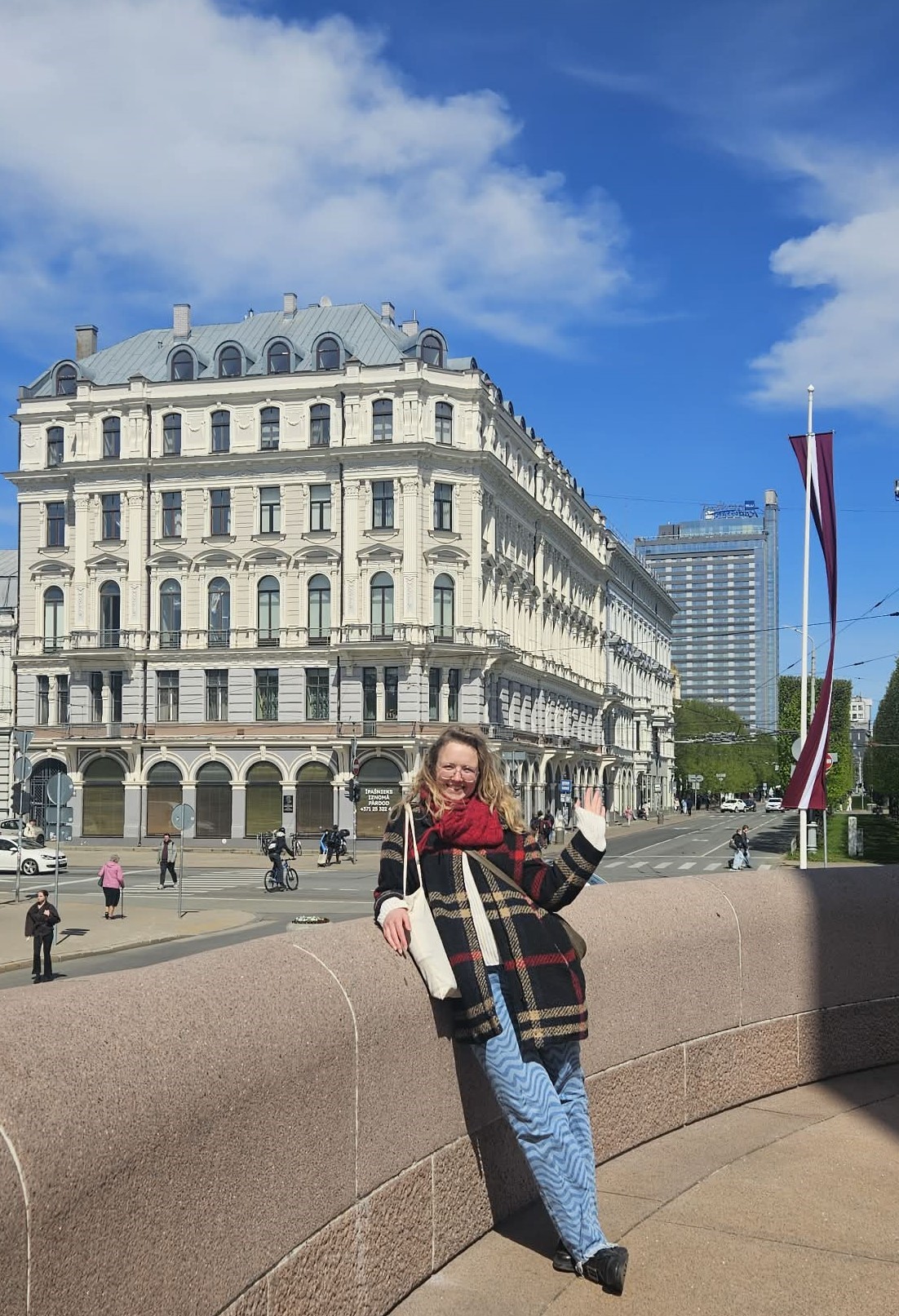
This interview is made possible thanks to the kindness and generosity of 𝗔𝘂𝗴𝘂𝘀𝘁𝗶𝗻𝗮 𝗞𝘂𝗻𝗱𝗿𝗼𝘁𝗮𝗶𝘁ė, who graciously agreed to share her story with our community.
As a lovely reminder of where every journey begins, Augustina wrote her BA thesis on Privacy, Surveillance and the Individual in Dave Eggers' Novel The Circle. Today, she works as an English Language and Literature teacher in a Waldorf/Steiner school in Ireland, continuing to build an inspiring professional career that demonstrates just how transferable and valuable the skills gained through English Philology can be.
We hope Augustina's story will inspire those who are about to graduate next year, those who are just beginning to think about their future, and those who are considering becoming part of our community.
Welcome—and enjoy the interview!
🌷🌿 What did your path look like from graduation to your current job? How many different jobs have you held along the way?🌷🌿
At the moment I am an English teacher, but these questions reached me during a transitional phase of my career, as I am moving countries, and after 8 academic years in Lithuanian education, I will start this September in an Irish Waldorf/Steiner School. But to come back to the start of my career path I could state to not have changed that many jobs, but I have worked in multiple workplaces at the same time, hence my career was not linear, but rather ‘blended’, inter-connected and perhaps even rhizomatic. First of all, during the third year of English Philology studies, I started working as an English tutor in a private tutoring school, where I gained vast experience in finding out about students’ difficulties and challenges learning English as a second/foreign language. Two years later, while still working as a tutor and finishing the last year of BA studies, I was hired in a state school, where I worked for 5 years as an EFL teacher and gained the Senior Teacher qualification category. 3 years into tutoring and 1 year in public education, together with a fresh BA diploma, I decided to enter MA studies ‘Educology’ and, at the same time, to quit my position at the tutoring school. Though tutoring has not left my work path, my main focus forward became education at school. A year later, I also entered professional studies ‘School Pedagogy’ and got an offer from Vilnius university to join a project to suggest education innovation to the sector. I became a part of a research-project team with my colleague/mentor at the state school and MA supervisor, and our implemented innovation was a 14 experimental lessons cycle about the Climate Crisis integrated in the 1st grade National Natural Sciences Program. We presented our results in a conference and published a joint article in Acta Pedagogica Vilnensis:
https://www.journals.vu.lt/acta-paedagogica-vilnensia/en/article/view/36262
After the research project, I was offered a position in a Waldorf/Steiner school to try my hand at alternative education. For two years, I worked both in state and alternative schools, witnessing the differences between mainstream and holistic pedagogies, and at the same time conducted an extensive two year long post-qualitative MA study, researching the practices/methods applied in the Waldorf schools that could mirror post-humanistic pedagogy ideas and contribute to the possible solutions of the climate crisis (Thesis title: Developing Child-Nature Relationship in Waldorf Schools as a Response to the Climate Crisis: Possibility or Reality?). The thesis was written in English, the language that due to the first studies became my main academic language. After defending my thesis last year I left the state school and have been solely focusing on alternative holistic Waldorf/Steiner pedagogy, working as an ESL teacher and from the upcoming September I am teaching English Language and Literature in a Waldorf/Steiner School in Ireland. Working in Waldorf/Steiner pedagogy I am not only exploring the possibilities of teaching English in an immersive, project based and interdisciplinary manner, but this also gives me the opportunity to research possibilities of Nature, Climate Crisis and Anti-Anthropocentrism integration into state education.
🌷🌿Which specific competencies gained during your studies are most useful in your current work? 🌷🌿
One of the skills that we practised extensively was analytical thinking, especially present in literature courses. The deconstruction and dissection of the fiction based on theoretical frameworks, historical and philosophical contexts demonstrated how a constructive process of analysis works and influences the ability to look at the issue in question as if from the ‘the bird’s view’, observing it from a sort of distance. This taught me to perceive the phenomena from different perspectives without subjectively judging whether it is ‘good’ or ‘bad’, but rather to see it as it is. Of course, naturally one does form a subjective judgement, but what the studies showed me is that the subjective judgement is a personal choice based on your values, experiences or other aspects and the fact that others choose/think differently does not mean one judgement is superior or below the other, it is simply different and can be agreed or disagreed with. Therefore, the crucial importance of expressing ourselves in an argumentative and critical manner was also taught and carried out in numerous writing assignments, which helped me to learn and perfect academic writing. Consequently, this area became one of my strengths in personal academic and professional work, and nowadays it is an intellectual pleasure to teach students to communicate their opinions and ideas in constructive, consecutive and analytical fashion, which, I believe, is of utmost significance in the world of today, where expression of oneself has become fragmented and distorted not in a Joycean type of style, but in technocratic and AI-limited manner.
🌷🌿Do you have any advice for current students who are just starting to think about their career paths? 🌷🌿
I do not know if this could be categorised as ‘advice’, but a sincere wish: I wish you courage to make mistakes, forgive yourself for them, and view them as opportunities for growth—both in your professional and personal life. I also encourage you to trust in yourself and your ideas! Be bold in proposing them within the sector of your choice, yet remain open to criticism, which is key to improvement. Seek out like-minded people and join communities that can help drive the changes we so deeply desire for future generations. And most importantly, remember that all of this comes with responsibility; learn to embrace it for both successes and failures, for that is exactly what brings true liberation in every sense.
💚 Thank you, ❤️𝗔𝘂𝗴𝘂𝘀𝘁𝗶𝗻𝗮!❤️🌿
🤍