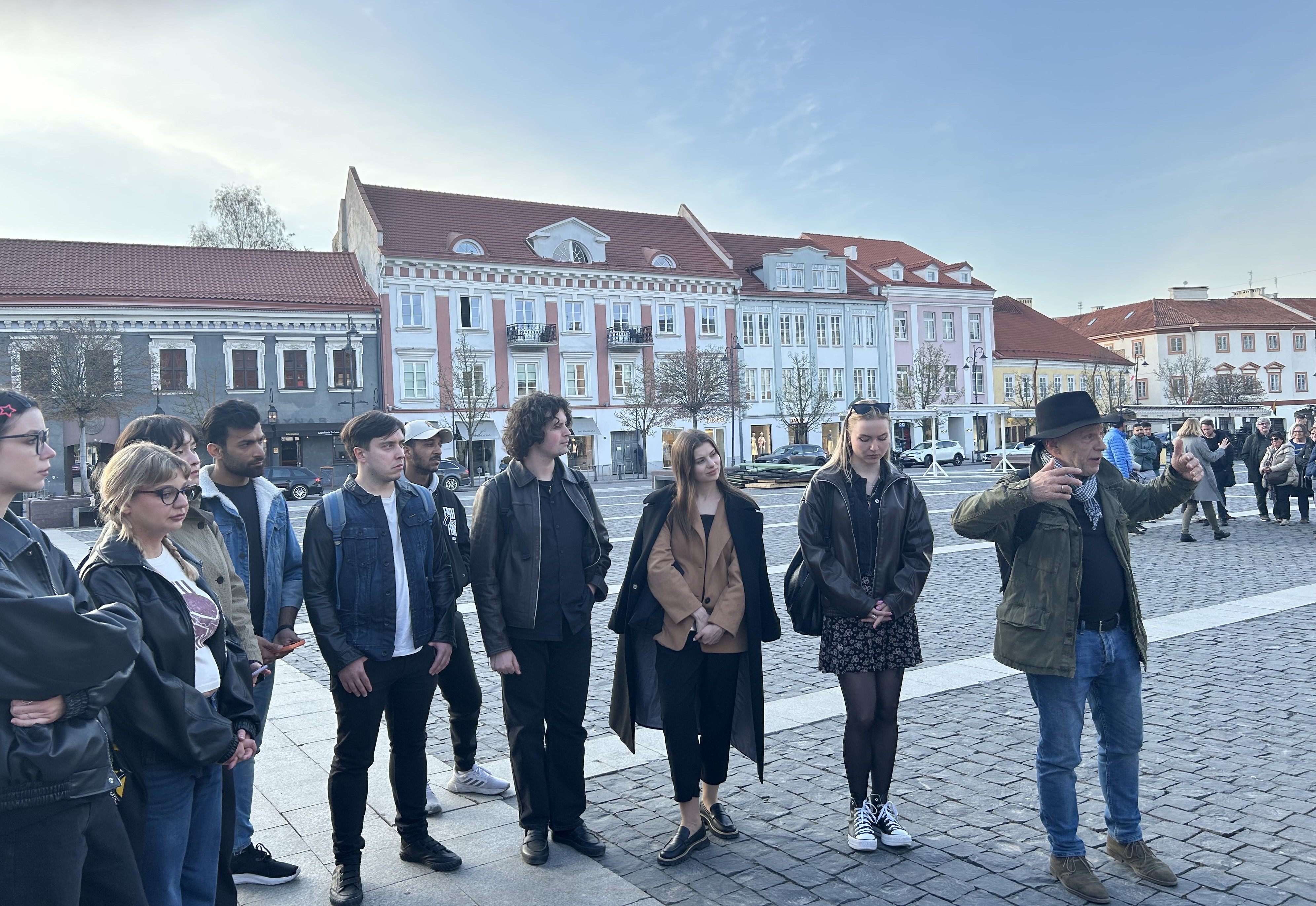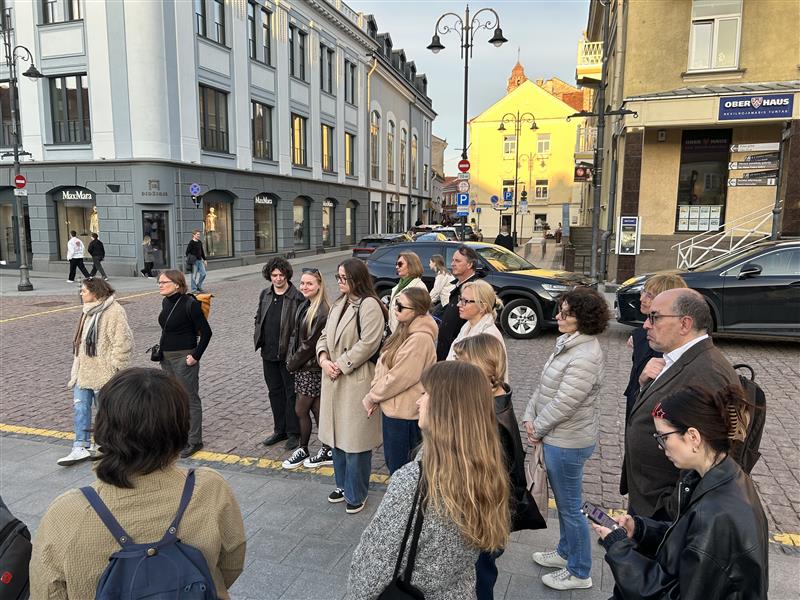
Today’s pre-conference walk, “Public Spaces, Body and the Sense of Place”, led by Almantas Samalavičius, was less about looking at Vilnius and more about feeling it. It invited us to notice how we move through the city, how spaces shape our bodies, and how memory lingers in places even when their forms have changed from the past.
We began the walk at Vilnius Town Hall, a place that appears open and where the surrounding buildings provide a sense of security and comfort. In the past, it was dense with life, filled with shops, activity, and the everyday presence of people. It would have been rich not only visually, but sensorially, shaped by sounds and smells. What stands now is the result of many transformations since the early 16th century, a reminder that architecture is never original in a pure sense, but always evolving.
Throughout the walk, the emphasis remained on the idea that architecture is not merely visual. It is something experienced through the whole body. Cities are encountered through scale, texture, sound, and even smell. Earlier urban environments tended to remain closer to the human body and therefore felt more grounded.
The walk continued to Konstantinas Sirvydas Square. The attention turned to the effects of historical change. The square, shaped by loss and partial reconstruction, stands as an example of an unresolved urban condition. It raises the question of whether cities should attempt to rebuild what has disappeared or instead accept transformation as part of their identity. The fountain, introduced later, becomes an important element, suggesting how water can animate space and draw people in.
Walking along Pilies Street, the notion of public space expanded beyond squares. A street, too, functions as a public environment, structured by movement and interaction. Even with relatively few permanent residents, it remains active to this day.
The walk concluded with a visit to Cathedral Square. Unlike the enclosed medieval spaces that once defined urban life, this square is open and expansive. Historically, public spaces were often surrounded by buildings that provided shelter, protection from wind, and a sense of safety. Cathedral Square, influenced by later planning, feels more exposed and less contained. Yet it continues to function as a vital space because of the events, gatherings, and social activities that take place there.
A central theme throughout the walk was the relationship between public and private life. Human experience cannot be entirely public. It requires moments of enclosure and privacy. At the same time, public spaces must remain accessible, connected, and responsive to different forms of use. The most successful spaces are those that accommodate a diversity of activities and allow different rhythms of life to coexist. Every street and square can be understood as an extension of the human body.
Prepared by Viktorija Timpaitė, English Philology, Year 4.